

Think Visegrad Brussels publications
Browse all articles in category think visegrad brussels publications and discover more interesting topics! Filter the articles:

Policy Brief | A Paper Tiger or a Game-Changing Project: European Defence Industrial Strategy and Views from Central Europe

 20. 3. 2025
The first-ever European Defence Industrial Strategy (EDIS) was introduced by the European Commission and the High Representative/Vice-President for Foreign Affairs and Security Policy (HR/VP) in March 2024, addressing key challenges in the European defence industry. The strategy aims to increase European defence industrial readiness, encourage Member States to invest in the European defence industry, and reinforce joint European defence procurement and ownership. EU Member States from Central Europe have played a crucial role in supporting Ukraine after the start of the Russian unprovoked and illegal full-scale invasion in February 2022. They also stressed the need to focus the EU's efforts on new initiatives in the field of defence and the defence industry, such as the Act in Support of Ammunition Production or enhancing the European Defence Fund. Writes Timotej Kováčik, Junior Researcher/Analyst focusing on security and defense issues, the EU's Common Foreign and Security Policy, and energy security at the Slovak Foreign Policy Association.
Policy Brief | Elevating EU-NATO Synergy for Enhanced European Defence
20. 3. 2025For over two decades, there have been numerous attempts to define and frame the relations between the EU and NATO. Three joint declarations and significant steps ahead have been taken and yet, there is no clear vision of how these two organisations should work together more efficiently. The commonly accepted idea of cooperation sees “NATO pulling the strings and the EU pushing the funds” in accordance with their respective nature and scope. Is this unbalanced relation the most suitable strategy to counter current geopolitical threats? No. But can this cooperation be upgraded? Possibly, yet this appears to be easier said than done. Providing the EU with a coherent defence policy and a strong industrial base can be a great additional value for NATO and not just in the extreme case of a possible disengagement of the US. Writes Federica Mangiameli, Programme Manager and Policy Fellow for Defence and Security at GLOBSEC, in her Policy Paper.

Policy Brief | How to make the EU ready for Enlargement: Member States’ perspective
20. 3. 2025Russia’s full-scale aggression against Ukraine in February 2022 has brought EU enlargement back as a priority of the EU policy towards the neighbourhood and as a geopolitical tool to ensure peace, stability and prosperity on the entire continent. That resulted in the EU recognising the aspiration of the Associated Trio countries to join the EU and granting membership candidate status to Ukraine and Moldova in 2022 and to Georgia in 2023. In record time, the former two countries also started the EU accession process in June 2024. The accession process of the candidates from the Western Balkans also accelerated. Bosnia and Hercegovina was granted the candidacy status and accession talks with Albania and North Macedonia started in 2022. However, despite the general consensus that enlargement is a geopolitical necessity, the question posed by French President Emmanuel Macron in Bratislava in 2023 – How should we do it? – still remains unanswered. Writes Marta Szpala, a Senior Fellow in the Central European Department at the Center for Eastern Studies.
Policy Brief | Transformation of Ukrainian transport system and its perspectives for the EU integration
20. 3. 2025Russia's full-scale invasion of Ukraine has led to significant changes in the Ukrainian transport sector due to disruptions in supply chains, cargo flows, and damage of the country’s infrastructure. The Ukrainian transport system has undergone significant transformations. The country's borders with Russia and Belarus and its airspace have been closed. In the first months of the full-scale war, the temporary blockage on the operation of Black Sea ports forced Ukraine to develop land transport corridors to the EU countries and neighboring Moldova to enable both export and import of goods needed for the economy. Despite the ongoing war, Ukraine has accelerated a long-planned reform of the country's transport system to adapt its infrastructure to the EU standards and integrate it with the European transport network. Writes Sandra Baniak, a Research Fellow at the Centre for Eastern Studies in the Connectivity and Regional Integration Programme.
Policy Brief | After October 7: EU Policy Towards the Israeli-Palestinian Conflict in 2023-2024
20. 3. 2025The war between Israel and Hezbollah, after a phase of full-scale confrontation, was halted by an armistice concluded at the end of 2024. The situation, however, remains far from stable, and the effects of the crisis are long-term. The surprise caused by the 7 October attack was shared by the European Union. The new iteration of the crisis in the Middle East represented another major political challenge for the European community, overlapping with those related to the Russia-Ukraine war, the migration crisis and other pressing issues requiring Union’s involvement. The EU's policies towards Israel and Palestine came under scrutiny, and the situation once again highlighted the extensive level of divisions among the EU states, affecting the potency and perception of its actions. Writes Michał Wojnarowicz, an Israel and Palestine analyst in the Middle East and Africa program at the Polish Institute of International Affairs, in his policy paper.

Policy Brief | Will the Fund fund enough?
31. 12. 2024There is a plethora of ways in which the ETS2 revenues and Social Climate Fund financing can support decarbonisation among lower-income strata, accounting for differing needs of communities, regions and countries. When addressed in a timely manner, these initiatives can both serve the green and just transition. How exactly can the Fund be allocated and what are its capacities are the guiding questions of this policy brief, written by Rebeka Hengalová as part of the Think Visegrad research fellowship.
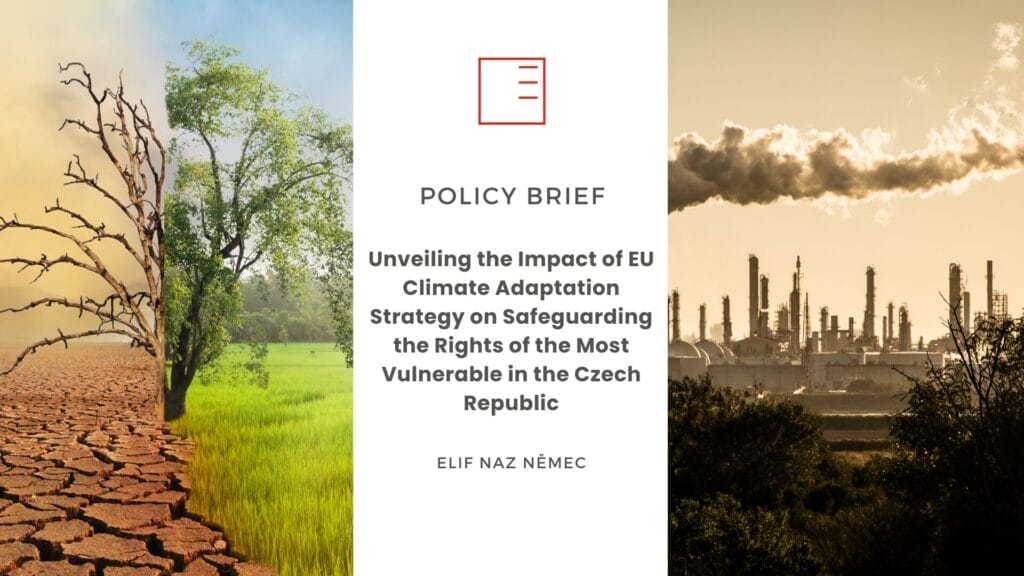
Policy Brief | Unveiling the Impact of EU Climate Adaptation Strategy on Safeguarding the Rights of the Most Vulnerable in the Czech Republic
16. 12. 2024The European Union has been implementing an ambitious agenda under the European Green Deal. Sustainable development and climate action have been prioritized as per the ambitious goals covered in the European Green Deal. However, as underscored by Ursula von der Leyen, the focus for the strategic priorities has recently shifted towards economic security, competitiveness, and defence. Yet, the climate crisis constitutes an unprecedented security threat for modern humanity and the development of resilience towards climate change should still serve as a precondition for the fulfilment of those strategic priorities. Writes Elif Naz Němec in her Policy Brief.