
 Home ›
 Institut EUROPEUM

 Filter articles:

Policy Brief | The Enforcement of the EU Forced Labour Regulation and Systemic Forced Labour Risks in Xinjiang
More info 15. 10. 2025
 15. 10. 2025
At the end of November 2024, the European Parliament took a major step by adopting Regulation 2024/3015 banning products made with forced labour on the EU market. The ban, which will enter into force in December 2027, applies to the entire supply chain, with enforcement carried out by national authorities within the Union and by the European Commission in cases outside the EU. Although the measure has a global scope, it faces a number of challenges, particularly in relation to Xinjiang. Forced labour practices in the region have been repeatedly documented and acknowledged by both the International Labour Organization and the United Nations. At the same time, Xinjiang is a key supplier of solar panels, critical raw materials, aluminium, PVC, and cotton, while forced labour there often takes the form of state-organised mobilization outside internment facilities, which makes its detection especially difficult. For this reason, as noted by Jan Švec, Research Fellow at the Institute of International Relations in Prague, enforcing the Regulation will represent one of the most complex challenges for the EU’s trade policy.

Policy Paper | Local and Regional Dimensions of the Climate Change
More info 15. 10. 2025
15. 10. 2025Regions and municipalities are not only sources of emissions and areas where the effects of climate change are most visible, but they also serve as important centres for practical climate policy solutions. They are significant implementers of climate measures, particularly in areas such as the use of renewable energy sources, promoting low-carbon transport and introducing adaptation measures to mitigate the effects of climate change. At the same time, they foster investment and innovation in the field of climate action, writes Veronika Oravcová, who, through a series of expert surveys explored the different manifestations of climate policies on the local and regional level.

Report | The Future of Transatlantic Relations: Between Unity and Uncertainty
More info 13. 10. 2025
13. 10. 2025On 19th June, the Brussels Office of EUROPEUM representing the Think Visegrad Platform organised a public event entitled ‘The Future of Transatlantic Relations: Between Unity and Uncertainty.’ The event took place at The Library Europe, Avenue de Broqueville 40, with a participation of 16 experts, researchers and civil society actors. The aim of the discussion was to critically assess the current state and future trajectory of transatlantic relations in light of shifting geopolitical dynamics, with particular focus on trade tensions, NATO’s evolving role, ideological divergence between the EU and the US, and external security challenges.
Blog | The Internet and the Struggle Over Moldova’s Political Future
More info 19. 9. 2025
19. 9. 2025Moldova stands at a pivotal crossroads as it approaches its September 2025 parliamentary elections, with the outcome set to shape the country’s orientation between deepening ties with the European Union or succumbing to the pro-Russian, Eurosceptic forces.
The political struggle is unfolding not only in official arenas but also across the landscape of digital media. How are online platforms shaping public debate? What impact might external information campaigns have on Moldova’s political future? Discover the answers in the full article by Anya Brown, a research assistant at EUROPEUM Institute.
POLL RESULTS | Influence of Czech MEPs 2025
More info 15. 7. 2025
15. 7. 2025It has been exactly one year since the current European Parliament officially took office following last year’s elections. To mark the occasion, the Institute for European Policy EUROPEUM conducted the second edition of its Influence Ranking of Czech Members of the European Parliament, based on a survey of experts, diplomats, and business representatives. The aim is to assess how Czech MEPs have fared during the first year of their new mandate.
Interview | Jan Farský: The EU is not a cash machine, but solidarity in action. The floods showed that it works
More info 14. 7. 2025
14. 7. 2025At the EUROPEUM Institute and European Parliament Liaison Office organised event titled "Fires, Floods, and Extreme Weather – How Does the EU Help?", MEP Jan Farský assessed how well the EU’s crisis response tools have proven themselves. The European Union released over €114 million from the Solidarity Fund to support the Czech Republic after last year’s floods. According to Farský, this is proof that EU instruments—including the rescEU mechanism—are effective not only on paper but also in practice. In an interview with EUROPEUM, he discusses the importance of prevention, the role of municipalities, and why climate and crisis policies must go hand in hand.
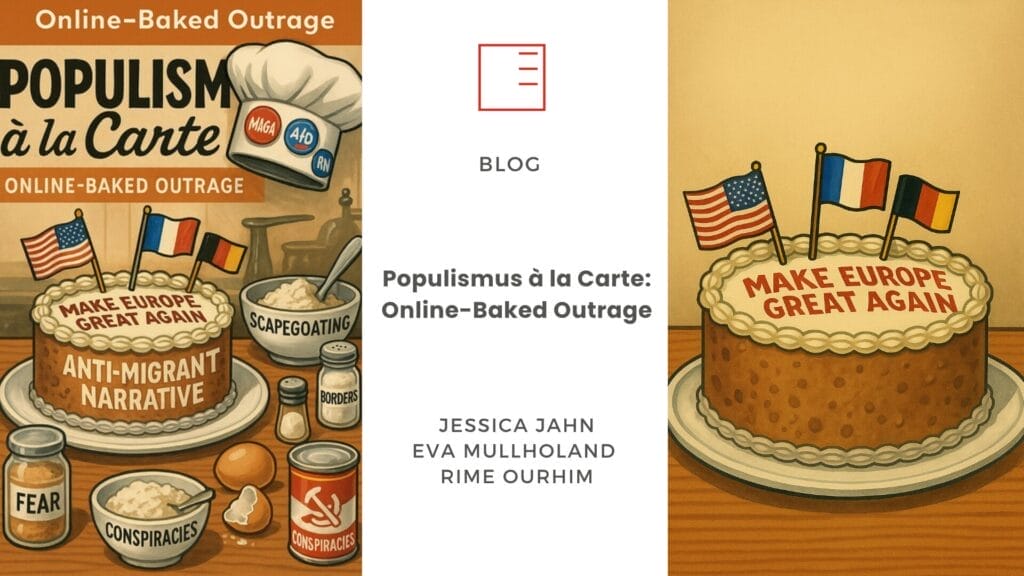
Blog | Populism à la Carte: Online-Baked Outrage
More info 4. 7. 2025
4. 7. 2025In the increasingly hostile political environment, every ingredient matters when cooking up public discourse. Take inspiration from world-famous chefs, Donald Trump, Alice Weidel, and Marine Le Pen, and learn the art of culinary science easily. This blog post was brought to you by our work-programme interns Eva Mullholand, Jessica Jahn, and Rime Ourhim.
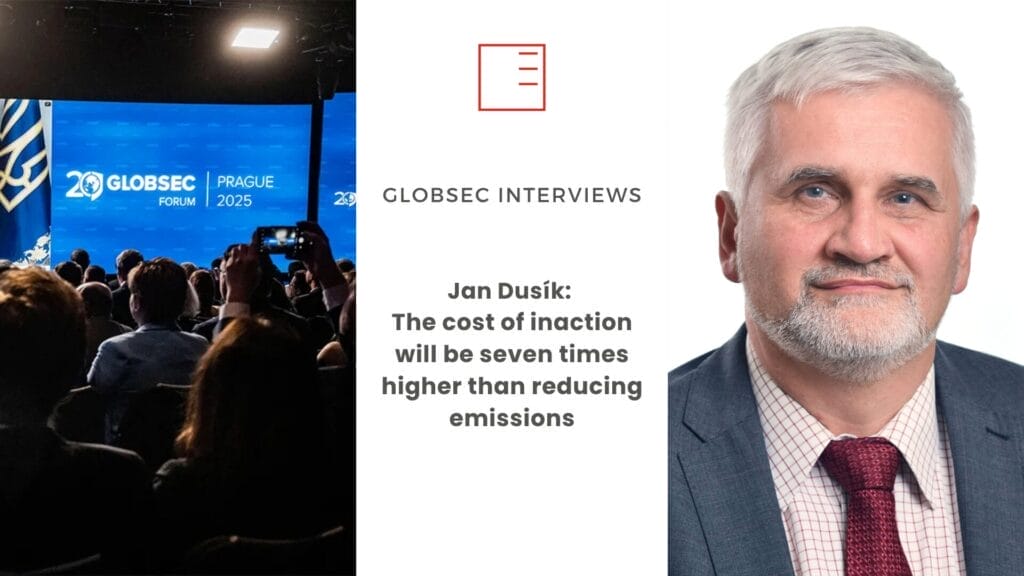
Globsec Interviews | Jan Dusík: The Cost of Inaction Will Be Seven Times Higher than Reducing Emissions
More info 12. 6. 2025
12. 6. 2025Jan Dusík is Deputy Director-General at the European Commission's Directorate-General for Climate Action (DG ENV). In his role, he focuses on linking environmental policies to public health and the protection of marine ecosystems. Previously, he served as Minister of the Environment of the Czech Republic and as Regional Director of the United Nations Environment Programme at the GLOBSEC Security Conference, where we discussed the link between climate security and Europe's green transformation.

Globsec Interviews | Rikard Jozwiak: EU policymaking drives me mad
More info 12. 6. 2025
12. 6. 2025Rikard Jozwiak is an accomplished journalist and seasoned EU observer currently serving as the Europe Editor at Radio Free Europe/Radio Liberty (RFE/RL) in Prague. With two decades of experience reporting on European Union and NATO affairs, he is recognised for his sharp analysis and clear-eyed commentary on complex international developments.
Prior to taking up his current post, Rikard was RFE/RL’s Brussels correspondent, where he covered numerous EU and NATO summits, European elections, and key international court rulings. His reporting has taken him across most European capitals as well as to Central Asia, offering him a rare front-row seat to Europe’s evolving role on the global stage.
With a journalist’s instinct and geopolitical insight, Rikard remains one of the most respected voices interpreting Brussels politics for global audiences.

Policy Brief | The EU's Tactical Approach and 'Conditional Engagement' with China in the Context of a Challenging Transatlantic Relationship
More info 30. 5. 2025
30. 5. 2025In this Policy Brief, Marcin Przychodniak analyzes the European Union’s current approach to China in the context of shifting transatlantic relations and growing tensions between the US, the EU, and China. The paper highlights key challenges – from increasing dependency on Chinese raw materials and investment concerns to the need for stronger EU defensive tools against economic coercion. It offers recommendations on how to more effectively protect European interests and security amid rising geopolitical tensions.
Position Paper | Civil society and industry demand measures to boost the use of recycled steel in the automotive sector
More info 21. 5. 2025
21. 5. 2025The European automotive industry is undergoing a major transformation. As EU legislation on vehicle circularity is being updated, non-profit organisations, think tanks, and representatives of the recycling sector are calling on the European Parliament and the Council to set more ambitious targets for the use of recycled steel in car manufacturing.
The signatories of the joint statement are urging stronger measures to ensure that recycled steel becomes a standard component in automotive production.
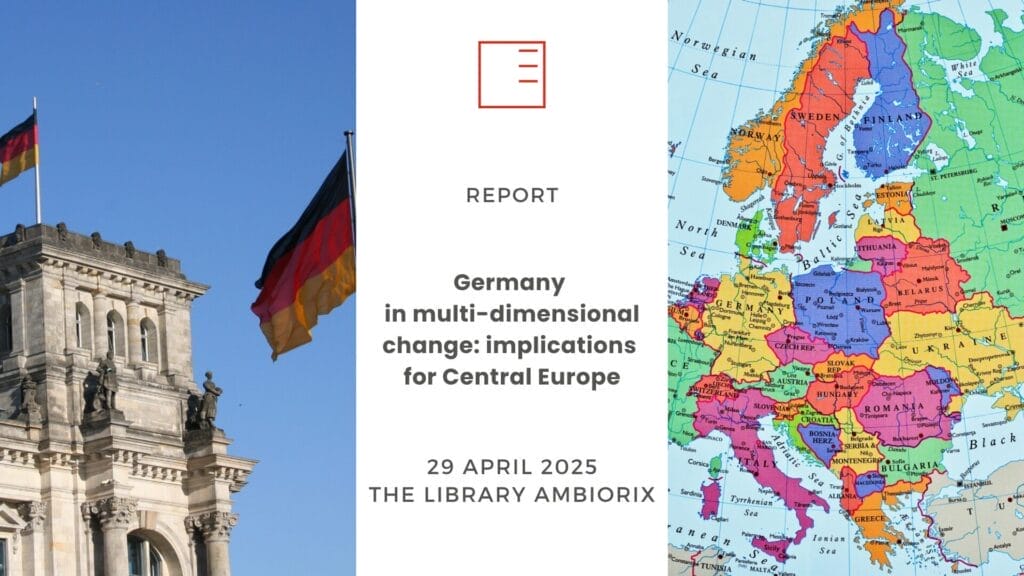
Roundtable Report | Germany in Multi-Dimensional Change: Implications for Central Europe
More info 19. 4. 2025
19. 4. 2025On April 29th, the Brussels Office of EUROPEUM, representing the Think Visegrad Platform, hosted an expert roundtable discussion entitled ‘Germany in multi-dimensional change: implications for Central Europe.’ The event took place at The Library Ambiorix, Square Ambiorix 10, under the Chatham House Rule with a participation of 14 experts. The aim of the discussion was to explore Germany’s ongoing transformation amid overlapping economic, geopolitical, and structural challenges, and their implications for broader European politics.