#TaskEurope 2026: Finnish President Alexander Stubb to Speak at the Conference
The conference will welcome one of today’s most prominent European leaders—Finnish President Alexander Stubb, who will open the first day of the conference at Prague Castle alongside his Czech counterpart, Petr Pavel.
Discussion: How can the ETS2 work for Central and Eastern European countries?
How ETS2 can be effectively implemented in Central and Eastern European countries? Come listen and discuss as the EU advances its climate policies, these countries face specific challenges and opportunities related to affordability, energy systems, and public acceptance.
What Does Viktor Orbán’s Defeat Mean for the European Union?
How does Hungary’s next prime minister, Péter Magyar, intend to govern? What does Prime Minister Viktor Orbán’s electoral defeat mean for the European Union? Viktor Daněk, Deputy Executive Director and Head of the Prague Office of EUROPEUM Institute, commented on the results of the Hungarian parliamentary elections for ČRo Plus.
Debate: Will the 28th regime give European startups a boost?
Join us for the next installment in our series of open debates, “What’s New in the European Parliament?” This time, we’ll discuss whether the 28th regime will give European startups the boost that’s expected.
Save the date: Join us for another beer on Thursday, April 23rd!
European Thursdays over a Beer continue! We’ll meet again on April 23 for an informal discussion focused on foreign policy and current European issues, as always in Smíchov. We’ll be joined by Kateřina Šafaříková, chief commentator at Seznam Zprávy, and this time we’ll focus particularly on the fact that “the Czech Republic sometimes acts as if it’s on its way out of the EU.”
About the EUROPEUM Institute
EUROPEUM is an independent think-tank focused on the European integration process. We conduct original research and organise public activities. We also formulate new ideas and recommendations to improve domestic and European policy.
Events
We organize regular seminars, debates, conferences, workshops and round tables focused on current European topics.
More info
Projects
Our long-term projects help to raise awareness of the European Union and strengthen international cooperation.
More info
Articles
Our research team publishes articles responding to topics related to European integration and more.
More info
Events
We organize regular seminars, debates, conferences, workshops and round tables focused on current European topics.
More information
Projects
Our long-term projects help to raise awareness of the European Union and strengthen international cooperation.
More information
Articles
Our research team publishes articles responding to topics related to European integration and more.
More information
Upcoming events
Past events

20. March 2026
Over the past 15 years, the New Green Savings program has significantly helped Czech households finance energy-efficient renovations. But what is the future of the program once the funds have been exhausted?

18. March 2026
JustGreen Project at the Climate Action Conference 2026
On March 18, at the “Science for Climate Action 2026” conference in Brussels, we presented our JustGreen project as part of a session focused on the experiences of citizens in the V4 countries with the green transition and its impact on their daily lives. Rebeka Hengalová, Research Fellow at EUROPEUM Institute, outlined the project’s main objectives and findings.

17. March 2026
Inside a Think Tank: Projects and Student Opportunities in Brussels
Are you a student in Brussels or planning a visit? Don't miss our event Inside a Think Tank: Projects and Student Opportunities in Brussels. Join us for an interactive discussion about the work of think tanks and opportunities for students interested in international relations, EU policy, and public affairs.

12. March 2026
Café Collaborations: Housing Accessible to All–Old and Young? Reality or Utopia?
This Thursday, March 12, Prague will host an English-language debate entitled Café Collaborations: Housing Accessible to All – Old and Young? Reality or Utopia? Together with experts from Austria, Spain, and the Czech Republic, we will explore why affordable housing in Czechia continues to be such a challenge and what we can learn from the experiences of other European countries.

26. February 2026
European Thursday over a Beer
Come by on February 26th at 5:00 PM to Pauwel Kwak Bierhuis for an informal debate on what EU membership really means for Central Europe. This session's Hot Take: > "Central Europe has adopted the Western standard of living but rejects Western standards of behavior—essentially: 'Gimme the money and keep your values.'" This time, we’ll […]

12. January 2026
What awaits us in 2026?
The year 2026 will bring new challenges for the European Union. Join us on 12 January 2026 to discuss them at a debate from the series ‘What’s New in the European Parliament?’.
In the Media
Projects
Publications

4. March 2026
Radiožurnál | The Industrial Accelerator Act is intended to support the development of green European industry
The European Commission has unveiled long-awaited measures to strengthen European industry and keep pace with China in the field of so-called clean technologies. In an evening news program on Radiožurnál, Rebeka Hengalová, a researcher at EUROPEUM Institute, discussed what the Industrial Accelerator Act entails and what protections it will provide for so-called green products manufactured in the EU.

2. March 2026
ČRo Plus | European leaders' response to US-Israeli attack on Iran is cautious but unified, expert sums up
Martin Vokálek, Executive Director and Head of the Brussels Office of EUROPEUM Institute for European Policy, summarized European leaders' responses to events in Iran for ČRo Plus.

26. February 2026
Seznam Zprávy | The prophecy is coming true. Europe is falling behind and has only itself to blame, says Křenek
Little is being done to avert Europe's economic decline. According to Filip Křenek, an analyst at the EUROPEUM Institute, member states must accept that some of them will have companies of global significance and others will not. Otherwise, Europe will not be able to remain competitive. He added what would be beneficial for the Czech Republic for Seznam Zprávy.

20. February 2026
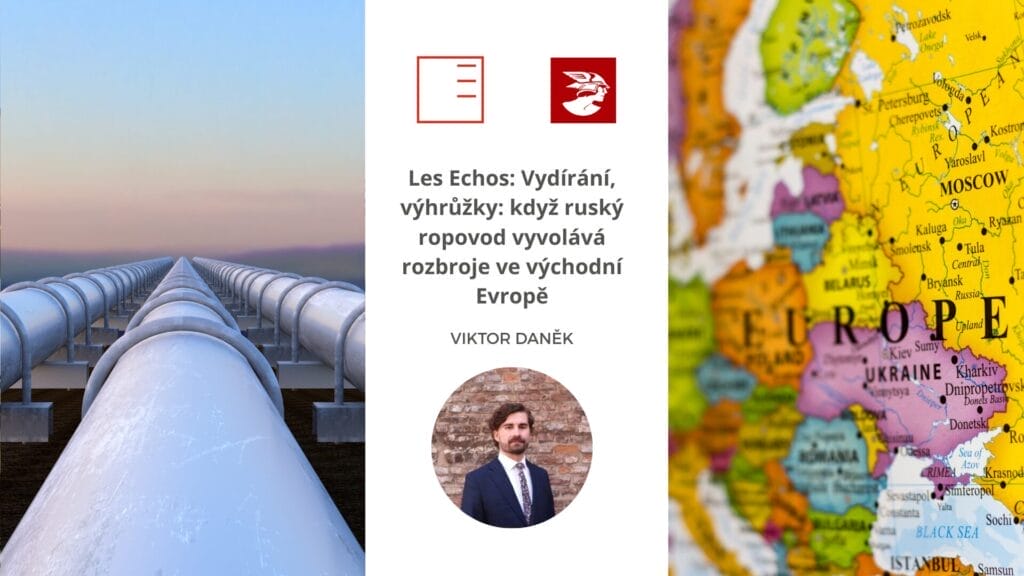
Les Echos | Blackmail, threats: when a Russian oil pipeline causes discord in Eastern Europe
Since the attack and damage to the Druzhba oil pipeline at the end of January, Hungary and Slovakia have been cut off from Russian oil. The leaders of both countries, who maintain good relations with Vladimir Putin, accuse Ukraine of delaying repairs to the pipeline. Viktor Daněk, Executive Deputy Director and Head of the Prague Office of the EUROPEUM Institute, commented on the series of accusations and threats for the French daily Les Echos.

13. February 2026
Seznam Zprávy | Another plan to boost the EU: Digital identity for all citizens and businesses
By the end of 2026, the European Union will introduce a unified digital identity for citizens and businesses. The EU Digital Identity Wallet will allow users to store official documents, sign contracts, and verify their identity across member states with just a few clicks. The initiative aims to reduce bureaucracy, cut costs, and remove barriers within the single market, while also raising concerns about data protection and the potential pressure to make the system widely mandatory. The article was commented on by Filip Křenek, analyst at the EUROPEUM Institute.

21. January 2026
voxpot | Diplomacy or bazooka? How will Europe respond to Trump’s threats?
U.S. President Donald Trump has escalated pressure on Europe through tariff threats and explicit challenges to Greenland’s sovereignty. The European Union is now weighing a response that balances diplomacy with tougher countermeasures, including the potential use of its so-called economic “bazooka.” Experts warn that without a confident and united stance, Europe risks further weakening transatlantic relations and its own global standing. Commented on by Martin Vokálek, Executive Director and Head of the Brussels Office of the EUROPEUM Institute.

2. December 2025
Low-emission materials for the Czech automotive industry
The Low Emission Materials for the Czech Automotive Industry project is the fifth EUROPEUM project aimed at decarbonising the Czech automotive industry. The aim of the project for 2024/2025 is to improve understanding of material flows and regulatory barriers in the automotive sector; to transfer best practices from the international context to the Czech environment; and to identify key areas of Czech and European policies that need to be improved to enable the automotive industry to meet the challenges of decarbonisation and remain competitive.

31. October 2025
Platform Revolution: shaping the future of work in the EU and Western Balkans
The Project centres around the fast development of platform work in the Western Balkans and the EU. This new phenomenon has witnessed fast growth since the pandemic, particularly with digital platforms like “Upwork”.

31. October 2025
REWEU
The project (Re)uniting the East and West: Reflections on the 2004 EU enlargement (REWEU) is focused on the commemoration of the 2004 “big bang” EU enlargement at the occasion of its 20th anniversary in May 2024. This event had numerous positive effects on shaping Europe as we know it today, boosting its security, economic potential, and spreading democracy, good governance and European values across the European continent.

1. October 2025
Prague Climate Academy
In 2023, the Green Europe Team of the Institute for European Policy EUROPEUM started a series of debates focused on communicating the topic of green transformation to the Czech public. The aim is to develop public debate and support journalists and civil society in informed discussions about climate change and climate policies. In its first year, the Prague Climate Academy focused on sustainability in transportation (decarbonizing road transport in connection with electromobility and the sustainability of transportation in Prague). In 2024, it continued with the topic of adapting cities to climate change and discussing the impacts of heatwaves on cities. The year 2025 brings the perspective of resilience, with a discussion of current trends in global temperature rise and extreme weather events, including their impacts on urban infrastructure and public health.

31. August 2025
Green Broadcast
The project Green Broadcast was launched on 1 January 2025 and will be ongoing until 31 August 2025.

31. March 2025
Impacts of the EU Emissions Trading System 2
This project examines the potential impacts of the EU Emissions Trading System 2 (ETS2) on Europe’s most vulnerable households, with a particular focus on mitigating risks that could lead to public resistance against the EU’s transport decarbonization policies. Its activities aim to contribute to the mainstreaming of the concept of transport poverty, its causes and solutions, in the Czech context.

18. December 2025
Blog | Affected by the Grey Digital Divide: How Digital Exclusion Prevents Older People from Accessing eHealth in Czechia
In this blog post, EUROPEUM intern Emma Šílová examines how digital exclusion continues to limit older people’s access to eHealth services in Czechia. Drawing on national data, EU and national strategies, and recent reforms in healthcare digitalisation, the article explores the barriers faced by older adults when accessing eHealth services, assesses Czechia’s performance in eHealth inclusion, and outlines policy recommendations to ensure that the digital transition in healthcare does not leave seniors behind.

17. December 2025
Policy Paper | EU Communication on Infrastructure Projects: a Geopolitical Response?
As there is a shifting trend towards a geopolitical framing of several EU-related policy areas, such as enlargement, agriculture and energy, a geopolitical turn in EU public diplomacy is an approach one must also contemplate in the highly competitive communication environment of today, writes Oszkár Roginer-Hofmeister. He argues that to tackle the challenges from Russia, China, and more recently the US, the EU is making an effort to rebrand itself as a geopolitical actor. Find out more in Oszkár’s text below.

10. December 2025
Policy Paper | Is There a Way to Overcome the Values vs. Utilitarian Divide? Two EU Campaigns in Hungary
Is it possible, in an environment of growing Euroscepticism and media polarisation, to connect the European Union’s value-based language with a utilitarian understanding of its role? Drawing on two EU communication campaigns in Hungary conducted in 2024–2025, the text examines this tension and shows that the clash between the EU’s normative framing and the Hungarian government’s transactional, sovereignty-centred narrative is not merely a matter of messaging, but a structural feature of the domestic political and media landscape. The analysis suggests that isolated campaigns have only limited capacity to shift public attitudes in such a hostile and saturated information environment.

9. December 2025
Report | From Partner to Rival: How Should Europe Respond to China’s Growing Influence?
On December 9th, the Brussels Office of the EUROPEUM Institute, representing the Visegrad Platform, in collaboration with MEP Miriam Lexmann and her office, organised a roundtable discussion titled ‘From Partner to Rival: How Should Europe Respond to China’s Growing Influence?’. The event aimed to explore how shifts in EU–China relations, driven by deepening strategic rivalry, economic pressures, and geopolitical uncertainty, are reshaping the EU’s strategic direction.

8. December 2025
Policy Paper | Between Control and Contradiction: The V4 in the Age of the EU Migration Pact and Labour Shortages
Since the 2015 migration crisis, the Visegrád Four (V4) countries – Poland, Hungary, Czechia, and Slovakia – have adopted strongly securitised migration narratives focused on control, sovereignty, and national identity. Although the region faces only minimal migratory pressure, migration remains a key political issue, often invoked during elections and EU-level negotiations.
Yet this narrative of exceptional threat contrasts with the V4’s growing dependence on legal labour migration from third countries, driven by shrinking working-age populations, structural labour shortages, and low wages in key sectors. This paper examines these contradictions and governance gaps, focusing on the tension between securitised political discourse and economic reality.

8. December 2025
Report | Prospects for the EU Enlargement in the Western Balkans: A Missed Opportunity or a Strategic Turning Point?
On October 1st, the Brussels Office of the EUROPEUM Institute, representing the Visegrad Platform, opened the month with an expert roundtable discussion titled “Prospects for the EU Enlargement in the Western Balkans: A Missed Opportunity or a Strategic Turning Point?” The event explored the achievements, shortcomings, and future outlook of the EU enlargement process in the Western Balkans, while promoting an open dialogue among leading experts and policymakers in the field.
Follow us on X
Listen to our Podcast
Contact Us
You can contact us by filling out the form below, by email, by phone or via social media.
EUROPEUM Institute for European Policy
Staroměstské náměstí 4/1,
110 00, Praha 1
110 00, Praha 1
+420 212 246 552
europeum@europeum.org